Google's Willow Wins a Quantum Game 98.3% of the Time, and Finds Hardware Errors Along the Way
The Willow quantum processor cleared 88.89%, the win-rate ceiling for any strategy relying on answers fixed in advance. Google also ran computational tasks at scales reaching 105 qubits.
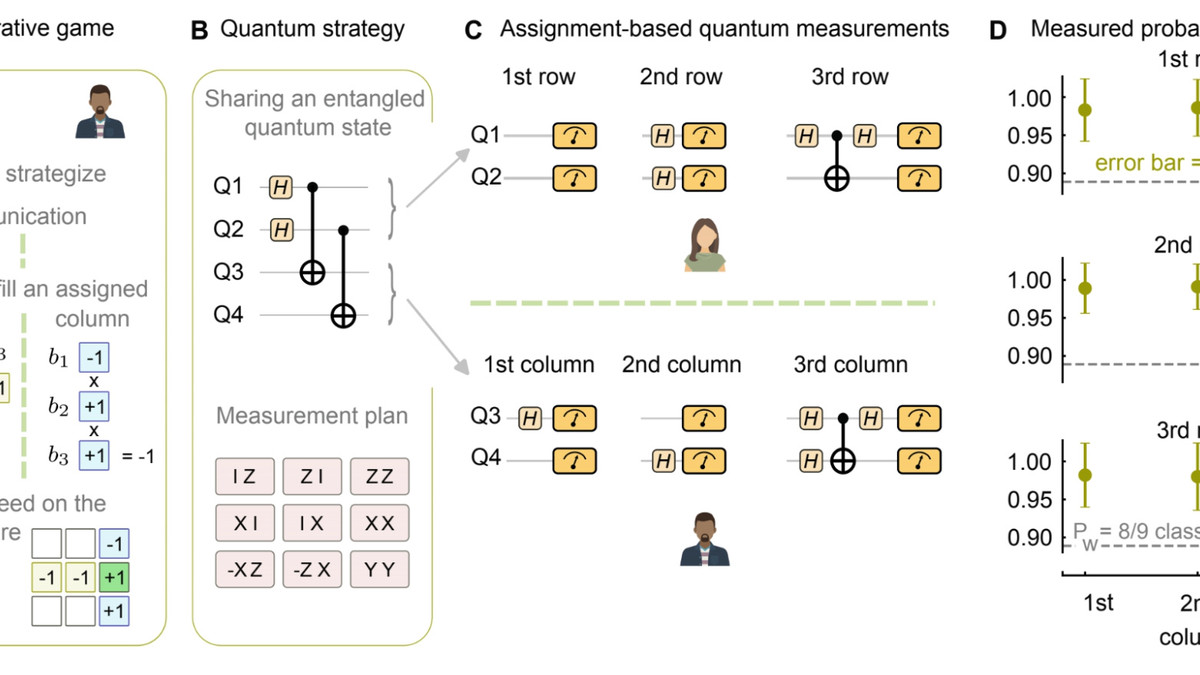
On November 19, Google’s Quantum AI research team published work that measures the distinctive properties of quantum computers through games and computational tasks. The company’s quantum processor, Willow, won a “magic square game” 98.3% of the time. The experiments scaled up to 105 qubits. A qubit is the basic unit a quantum computer uses to handle information. The team says the related research was published in the journal Science.
A 98.3% win rate, but at what game?
The game starts with a three-by-three grid. Each cell gets either +1 or −1, with one catch: the product of every row must be +1, and the product of every column must be −1. No grid can satisfy all of those conditions at once. The row rules require the total number of −1 entries in the grid to be even, while the column rules require it to be odd.
The researchers turned that contradiction into a cooperative game for two players. One fills in an assigned row, the other an assigned column. Without talking to each other, if each respects their own multiplication rule and both write the same number in the cell where the row and column intersect, they win together. Any strategy that relies on answers fixed in advance cannot win more than 88.89% of the time. The team reports that using qubits sharing an interlinked quantum state, it ran each of the nine possible cases 100,000 times and achieved a win rate of 98.30%.
Why the quantum computer did better
The property behind the gap is “quantum contextuality.” It means measurement outcomes are not determined from the outset but depend on which other quantities are measured alongside them. In a separate test designed to put a number on this property, the team reports measuring 5.590. If the values were fixed in advance, the score could not exceed 4; the maximum allowed by quantum mechanics is 6.
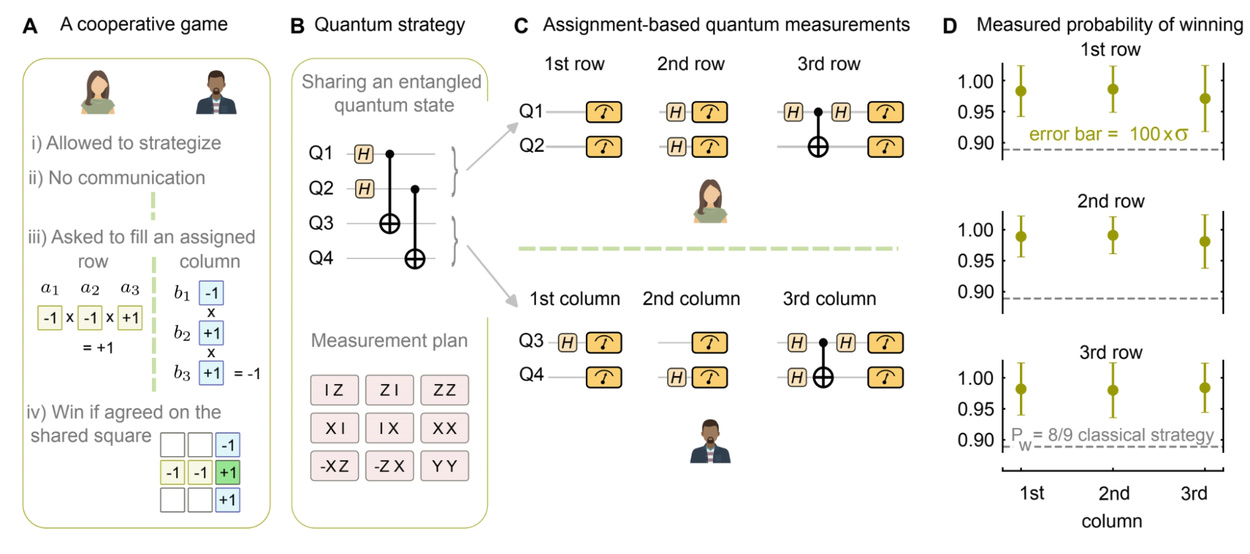
Image: research.google
The team also looked at whether the effect holds up on larger devices. It ran a game with up to 71 qubits in which multiple participants answer without communicating and the full set of answers must satisfy a prescribed even-or-odd condition. The advantage shrank as qubit counts rose because of noise, but at every scale tested the results still beat the ceiling for strategies that rely on answers fixed in advance, the researchers explained. They also say they separately verified entanglement spanning 45 qubits. Entanglement is the property by which multiple qubits form a single interlinked quantum state.
Beyond the games, the team ran a computational task of finding a hidden linear function on up to 105 qubits. It is a problem where quantum circuits are known to outperform ordinary circuits under the condition that the number of computational steps does not grow. The team reports that even as the problem size increased, the success probability stayed above one half without increasing the number of computational steps. A 2018 theoretical study showed that under such conditions there are problems quantum circuits can solve that ordinary circuits cannot.
Using games to find hardware errors
Another application the team proposes is checking the performance of quantum hardware. Because these tasks require many qubits to produce correct results simultaneously, they exposed subtle control errors, the researchers explained. Those are errors that tend to get washed out by averaging in the conventional approach of benchmarking performance with random circuits. The idea is that measuring the gap between actual results and either a perfect win rate or the maximum score allowed by quantum mechanics gives a read on how precisely the hardware is operating.
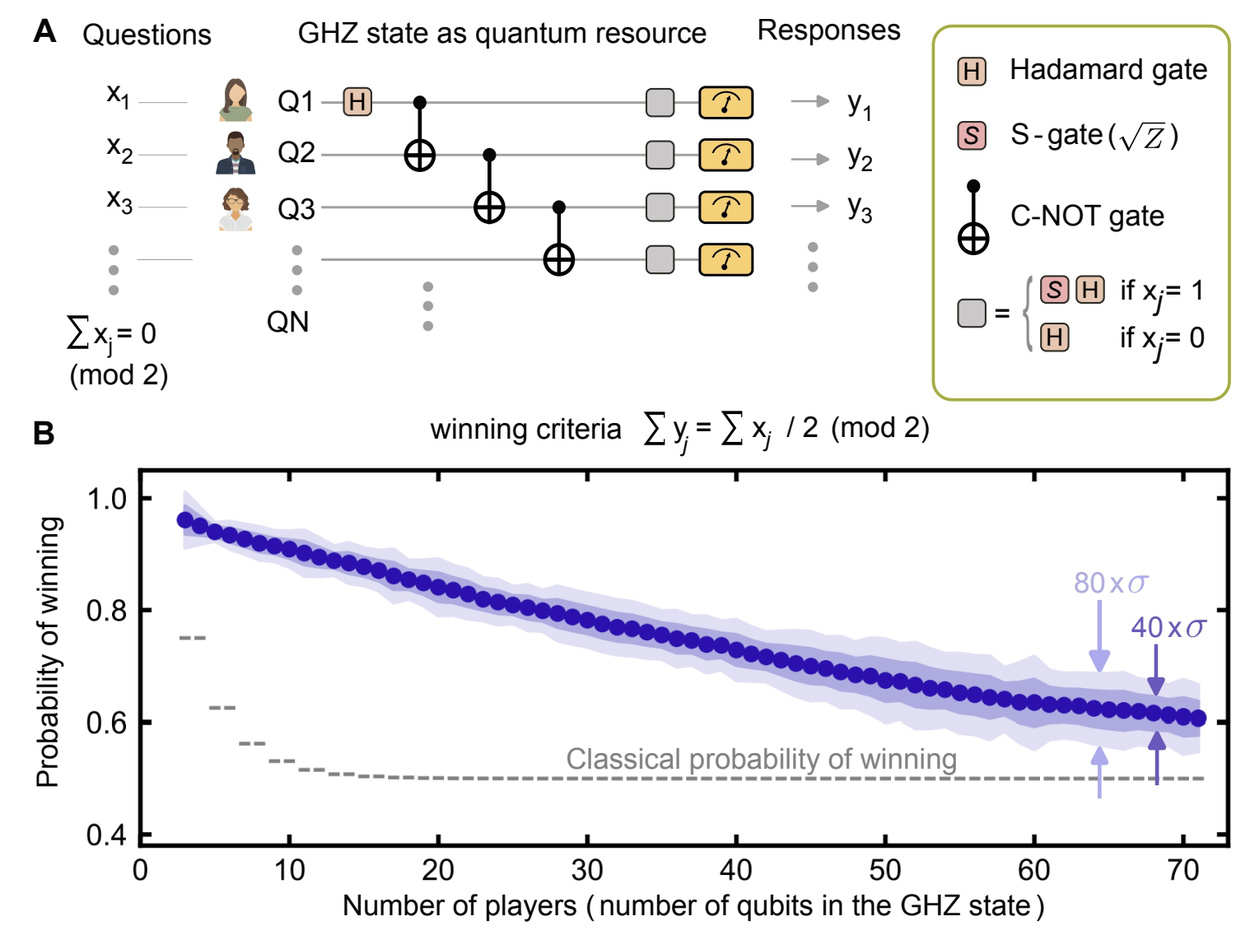
Image: research.google
Google says this kind of evaluation matters especially when running computations with fixed structure, such as molecular simulations for chemistry and materials research. Two things are worth watching from here: whether the computational advantage holds as qubit counts climb higher, and whether the work of reducing the errors uncovered here translates into better accuracy in real applied computations.