Predicting When a Fine-Tuning Job Will Finish: Average Error Falls From 12 Hours to 1.7 Hours
Dharma-AI has published research that forecasts fine-tuning run times based on 272 real-world jobs. By factoring in evaluation data volume and checkpointing overhead, the model cut average error far below conventional estimates built on compute alone.
In a November 18 post on the Hugging Face blog, Dharma-AI published research on predicting when an AI fine-tuning job will finish. The team analyzed 272 jobs run in a real production environment. A predictive model trained on past job records achieved an average error of 1.71 hours. The conventional approach, which estimates duration from compute volume, had an error of 12.41 hours.
Why Jobs Take Longer Than the Math Suggests
Fine-tuning means taking an already-built model and training it on additional data to adapt it to a specific task. The conventional method estimates duration from model size, the amount of training data, and the number and performance of GPUs. But real jobs also involve environment setup, downloading the model, and processing data. Running evaluations mid-training, uploading intermediate checkpoints, and uploading the finished model to storage all take time as well.
When multiple jobs share GPU infrastructure, they also share the network and storage. That, the researchers explained, is why jobs with identical compute requirements can finish hours apart. For the baseline comparison, they even folded the compute cost of scheduled evaluations into the conventional formula. Even when they varied the assumed GPU utilization rate across several values, the average error stayed above 12 hours.
How Past Job Records Delivered Accuracy
The new approach predicts duration using only configuration and model information available before a job starts. After comparing several predictive models, the researchers selected CatBoost, which produced the smallest error. The final model uses 24 features, including the total volume of data used for evaluation, checkpointing overhead, and workload per GPU. The estimate produced by the conventional formula is also fed in, so the model learns the gap between that estimate and actual elapsed time.
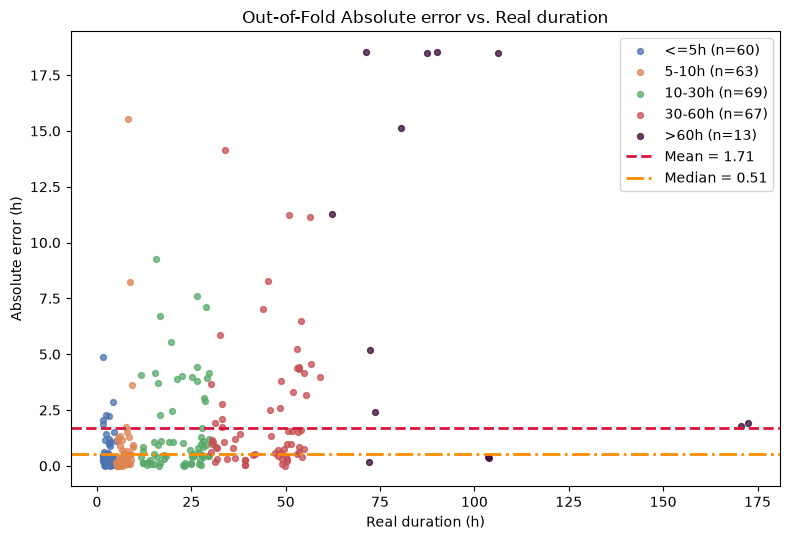
Image: huggingface.co
The jobs analyzed were fine-tuning runs executed on NVIDIA H200 GPUs. Models of up to 15 billion parameters were included, and each job was allocated one, two, or four GPUs. The environment also ran other training jobs and inference workloads concurrently. Actual durations ranged from 1.6 to 172.4 hours, with an average of 23.43 hours. Timing was measured from the moment GPUs were allocated until job completion, excluding queue time before allocation.
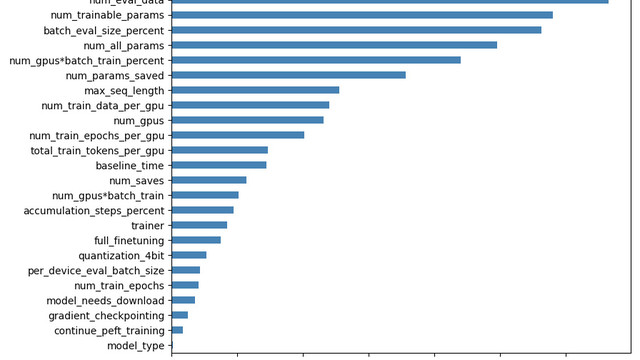
The researchers split the data into five folds and ran cross-validation, rotating which subset was held out for validation. The median prediction error was 0.51 hours, and 80% of all predictions fell within 2.20 hours of the actual time. The model’s most influential feature was the total volume of data used for evaluation across the entire job. The researchers noted that evaluation frequency and checkpointing settings also matter when examining expected duration.
How It Fits Into Training Schedules
The intended users of this research are AI development teams that share GPUs and the operators who manage that infrastructure. Knowing the expected duration before a job starts makes it easier to choose which jobs to run alongside it, the researchers explained. It can also help determine when GPUs will free up and whether a deadline is achievable. For teams fine-tuning AI for their own workflows, it provides a basis for factoring evaluation and checkpointing settings into schedules, not just model and dataset size.
Image: huggingface.co
How broadly the approach applies remains to be verified. This study was limited to supervised fine-tuning on labeled examples and to the H200 environment. Only 13 jobs ran longer than 60 hours, and error grew for those. The researchers stated that the model would need to be retrained for use on other GPUs. The full paper is slated for release on arXiv, and the next question to verify is whether accuracy holds up across other GPUs and training methods.