RadixArk Releases DaisyRose-27B, Lifting First-Try Success Rate to 12%
The company says further training of Qwen3.8-27B raised its first-attempt success rate on a computer-use benchmark from 5.6% to 12.0%. It is available for anyone to download under an Apache 2.0 license.

RadixArk released its first AI model, DaisyRose-27B, on November 18 local time. Built on Qwen3.8-27B, the model was further trained to carry multi-step jobs through to completion. The company says it trained on roughly 1,200 hand-picked tasks using 144 H200 GPUs over 18 days.
How well does it finish long jobs?
The biggest change is in the success rate of agentic AI, meaning models that handle work on their own. According to RadixArk, on Terminal-Bench 4.1, a benchmark for computer-use tasks, the share of problems solved on the first attempt rose from 5.6% for the base model to 12.0%, a gain of 6.4 percentage points. The company says the model also scored higher than the base model on other benchmarks measuring reasoning, instruction following, and coding.
The training tasks were built around the places where the base model tended to fail. Working with Eigent AI, RadixArk gathered thousands of candidate tasks across fields such as software development and science. The team studied where the base model broke down, tuned the difficulty accordingly, and fixed or dropped tasks that could be passed without actually solving the problem.
Tasks were designed so that multiple stages, from planning to execution, chain together. Each attempt was given up to 1 hour and 30 minutes, and long jobs involving more than 100 tool calls were included in training. A single training session ran as long as 1 million tokens. The amount the model can read at once is 256,000 tokens, the same as the base model, so longer sessions were handled by summarizing intermediate content and splitting each session into multiple trajectories.
How did it cut training costs?
RadixArk ran task execution and training at the same time using Miles, its own open-source training framework. While 128 GPUs worked through tasks, the remaining 16 trained the model on the logs those runs produced. Each time a training step finished, the new model was handed back to the task-running GPUs. The company says this cut the time the two sides spent waiting on each other.
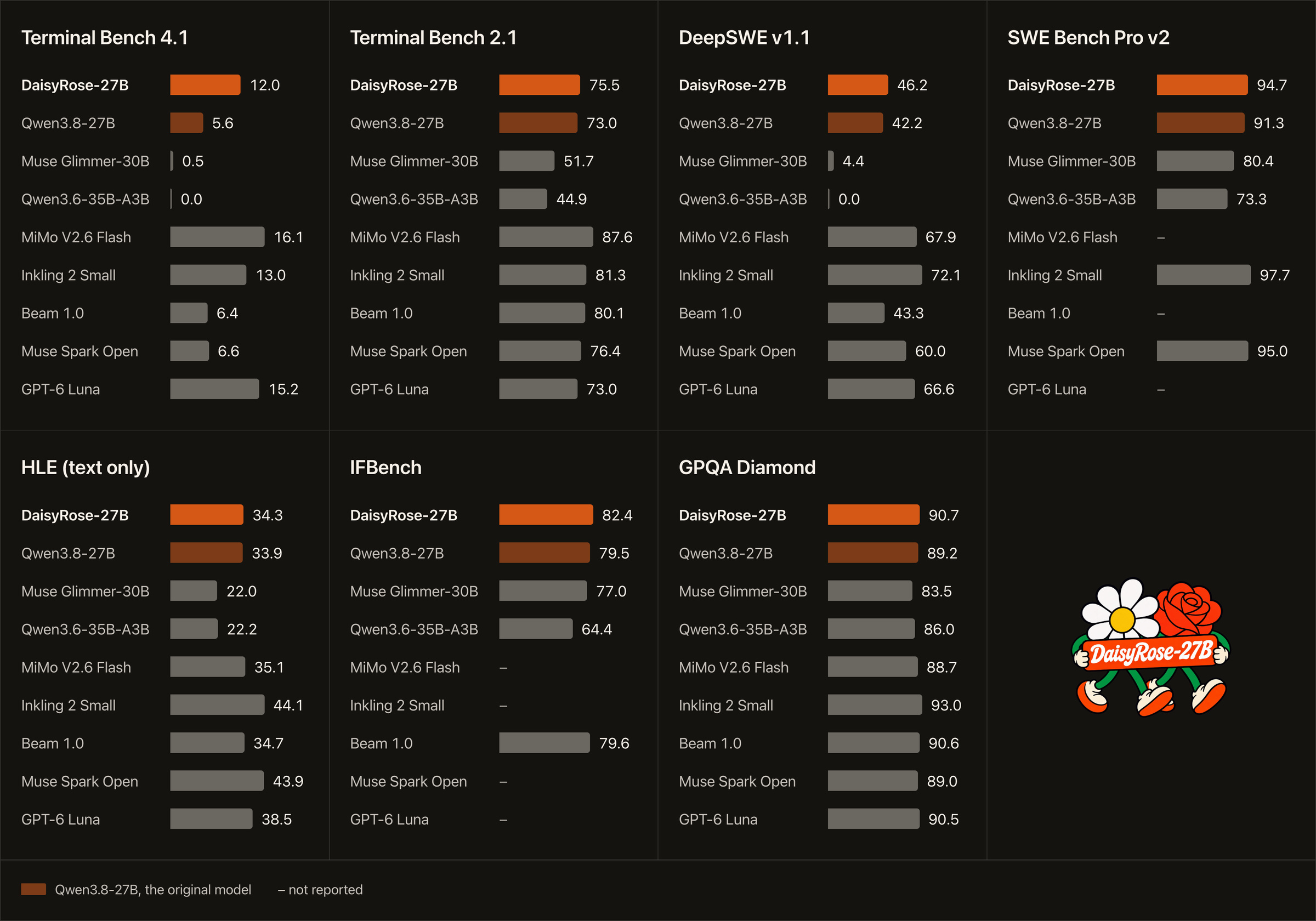
Image: huggingface.co
The company says that for the same training, its in-house training system used 57% less GPU time than the open-source training system it compared against. It added that overall throughput, including the time the AI spends carrying out tasks, was roughly double on the same number of GPUs.
Can you use it yourself?
DaisyRose-27B can be downloaded and run on your own servers under an Apache 2.0 license. The image understanding capability of the original Qwen3.8-27B is preserved. By default, the model works through a problem before producing an answer, and that reasoning process and the final answer are returned separately. SGLang is the recommended serving framework, and launch configurations for specific GPU types can be found in the SGLang cookbook.
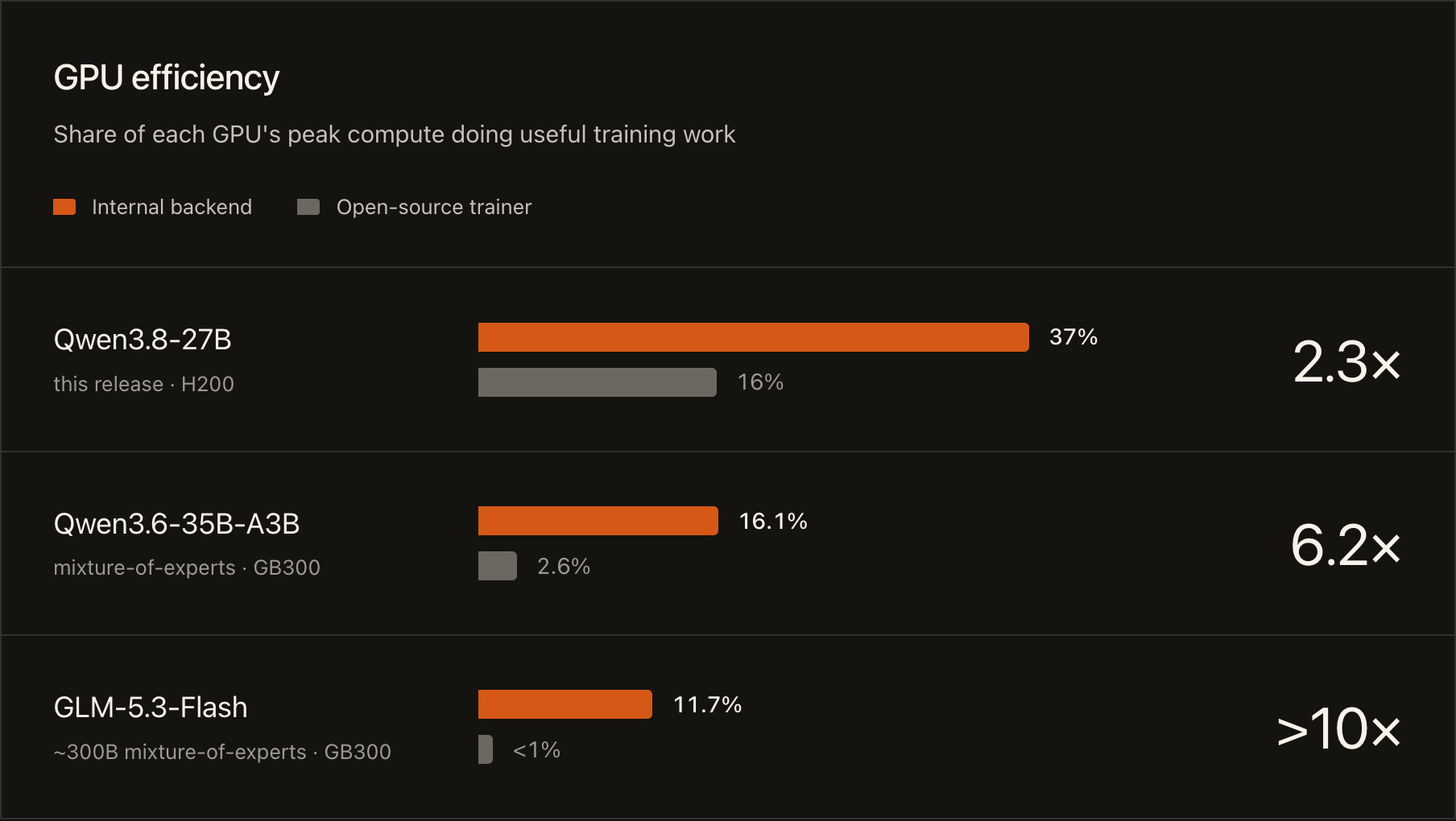
Image: huggingface.co
Two things make this release worth watching: the ability to see long jobs through, and what it costs to teach that ability. RadixArk says it made gains on both by reworking how tasks are selected and how its training system is built. For users considering it for real work, the question is whether success rates improve on their own jobs. The company asked people to report not only what worked but also what did not, along with details of their runtime environment.