Google Unveils AI That Chooses Among Options, Evaluating 1,000 Questions on a Single Input
Feed it text, photos and audio at once, and it picks an answer from a fixed menu of options, returning probabilities and a confidence score. Pricing is $0.10 per million input tokens, with no charge for the answers it produces.
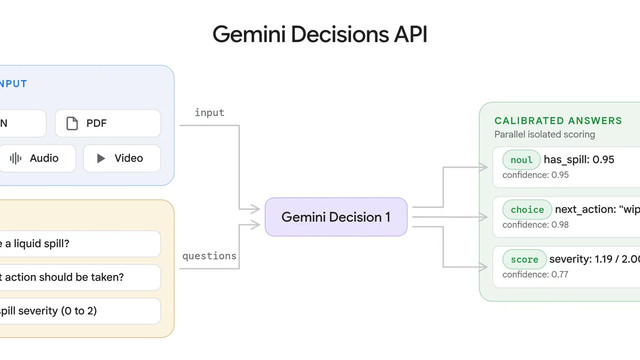
Google on November 11 local time unveiled the Gemini Decisions API, a system that picks an answer from a fixed set of options. Developers plug the new model, Gemini Decision 1, into their own services. It is available through the Gemini API in Google AI Studio. Rather than writing long passages of text, it is built for jobs like choosing which tool should handle a task or judging whether a rule was followed.
An AI that answers with options instead of prose
The model does not write out its answer one piece of text at a time. Instead, it lays out all the candidates at once and compares them. Text, images, audio, video and PDFs can all go in together, and up to 1,000 separate questions can be asked about the same material. The maximum it can read in one pass is about 256,000 tokens. Think of pairing a call recording with account details and reviewing them together, or examining a scanned insurance claim alongside photos of the damage.
There are three kinds of questions: yes-or-no questions, questions that pick one from several candidates, and questions that assign a graded score. The candidate-picking type compares anywhere from 2 to 255 options and returns both the selection and the probability for each candidate. Every answer comes with a confidence score between 0 and 1. Developers can use that score to route only the ambiguous cases to another process or to human review.
Answers in 0.25 seconds, and how much the bill shrinks
Google says that when the input is within 16,000 tokens, the median time from sending a request to receiving a result is 0.15 to 0.25 seconds. Counting only the model’s own computation time under the same conditions, the median is 0.05 to 0.1 seconds. According to Google, raising the number of questions packed into a single request from 1 to 100 barely changes how long it takes.
Source: Google (press release)
Google claims Gemini Decision 1 outperformed its comparison set on benchmarks covering task routing, reasoning, ranking and multimodal understanding. It also says the gap between the model’s self-reported confidence and its actual accuracy was the smallest of the group. On those same tests, the company added, the cost is roughly one-fifth that of Gemini 3.5 Flash-Lite used through the Interactions API.
It is already inside Google’s own products
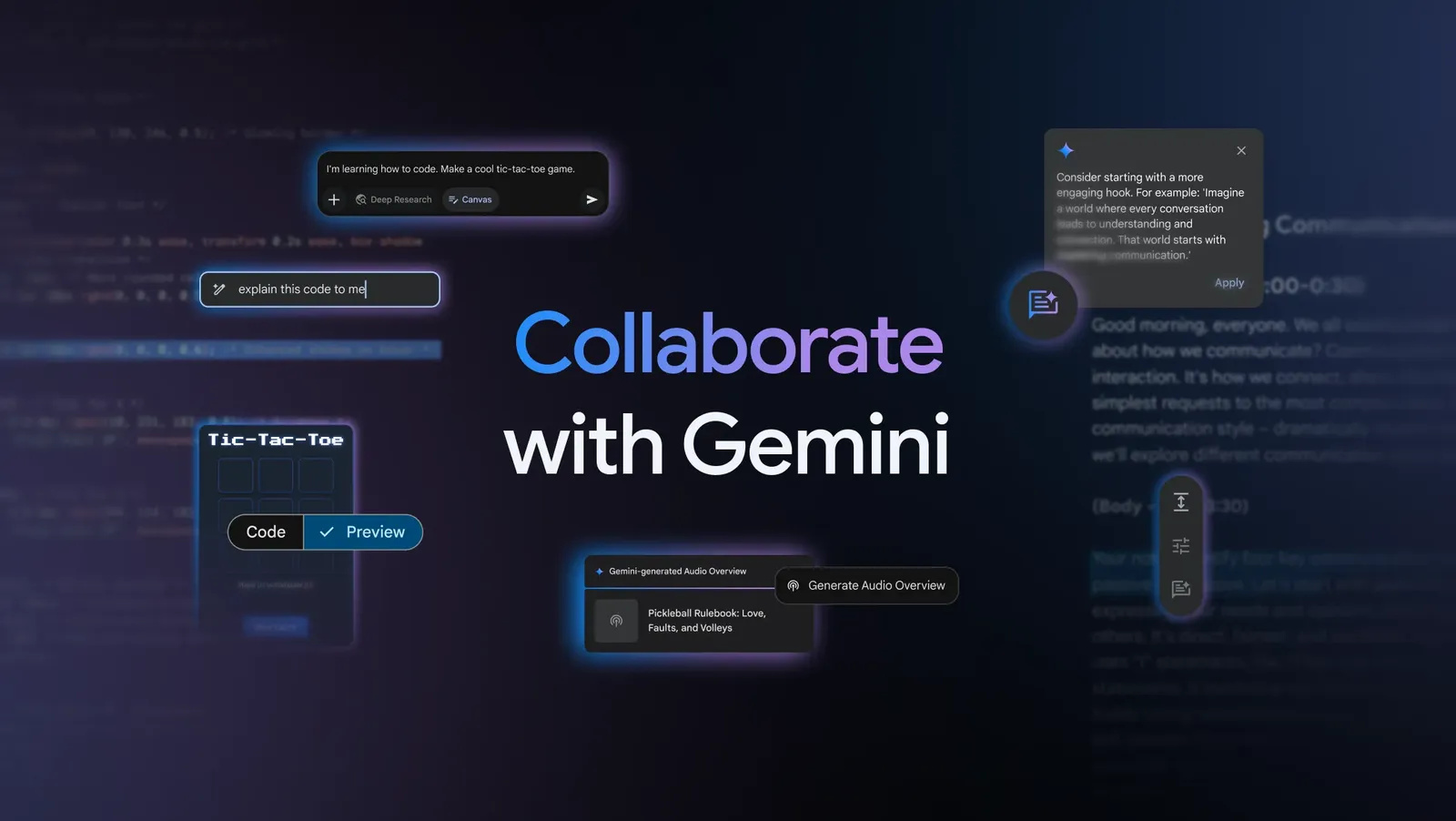
Google says it is already using the capability across its services. In Gemini Notebook, it selects the right model and reasoning depth for a given question, cutting response time for routine queries by up to 40%. A new experimental feature in Stitch drafts product screen flows in seconds and reacts quickly to edits made by voice or touch. CC, from Google Labs, uses it to pick a reaction emoji from more than 200 candidates.
Source: Google (press release)
Pricing is $0.10 per million input tokens. A token is the unit used to count pieces of text. There is no charge for the answers the model produces. Input shared by multiple questions in a single request is counted only once, while the instructions and grading criteria attached to each individual question are counted separately. Google says there is no extra cost for transcribing speech or reading text out of images, either. Google AI Studio also includes a free tier for prototyping.
Google signaled that it will roll out integrations with third-party developer tools over time and make the capability available through Gemini on Google Cloud as well. For end users, the difference may show up in how questions get routed to the right model or in how fast screen edits respond. Whether that selection accuracy and processing speed hold up in real-world workloads is the thing to watch next.